
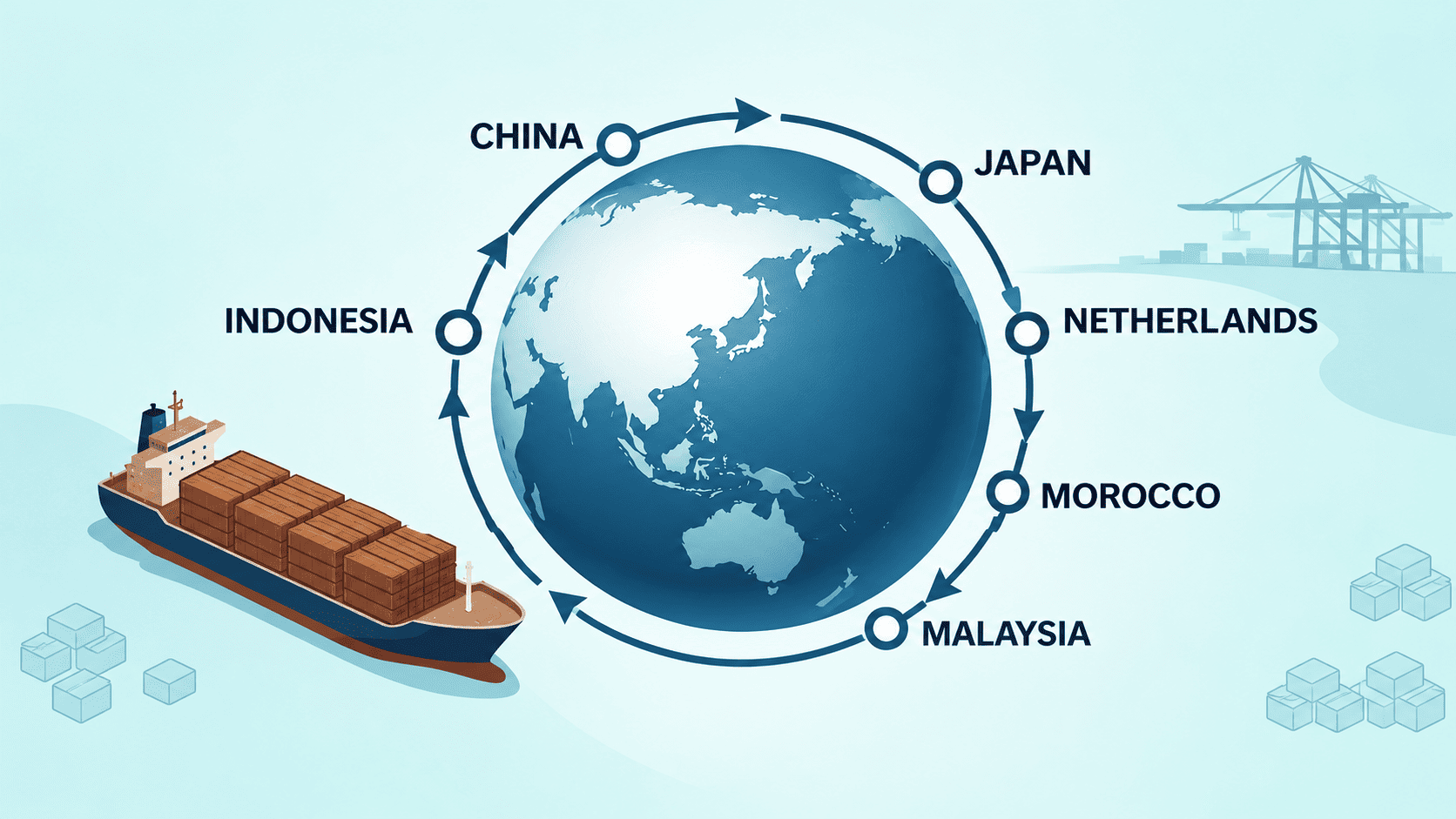
Coconut derivatives have quietly become an essential innovation in agriculture, especially for coco peat, coco fiber, coco husk, and so on. Derived from the fibrous husk left over after coconut processing, these materials now anchor production in commercial greenhouses and plant nurseries globally.
Indonesian processors are well-positioned to serve both HS 53050090 and 53050022 demand from the same raw material, reducing waste and giving exporters flexibility to shift output toward whichever product category the market is currently favoring.
Global demand for Indonesian cocopeat continues to experience rapid growth. Valued at billions of dollars, this commodity has become a primary target for major industrial markets across Europe, the United States, and Asia, including China and Japan.
Why choose Indonesia?
- Abundant Raw Material Supply
Indonesia is one of the largest coconut-growing areas in the world, with 3.3 million hectares of plantations. This scale gives the country more than enough husk supply to sustain both fiber-grade and peat-grade coir processing year-round.
Unlike smaller producing nations, where processors often face supply constraints during off-seasons, Indonesia benefits from an equatorial climate that allows coconut harvesting across the archipelago throughout the year. This mitigates regional supply volatility and keeps coconut fiber availability relatively stable. As a result, buyers do not need to maintain larger safety stocks or contend with seasonal price fluctuations.
For international buyers seeking these products, this translates to a lower risk of supply disruption. Producers entering into long-term supply contracts can also plan their operations with greater confidence, compared to working with suppliers whose harvest seasons are concentrated within a limited timeframe. - Strategic Location, Shorter Transit Times
Geographical factors significantly influence the competitiveness of coconut fiber exports. Indonesia’s location in Southeast Asia allows for significantly shorter transit times to key import hubs such as China compared to South Asian competitors. This translates directly into lower freight costs per container and faster delivery times. For buyers placing large or recurring orders, this time saving yields cumulative benefits: saving several days per shipment—multiplied by dozens of shipments annually—results in substantial advantages regarding both cost and reliability.
This advantage of geographical proximity is not limited to the Chinese market. Indonesia’s location also enables efficient access to other rapidly growing regional markets, such as South Korea, Japan, and neighboring ASEAN nations like Vietnam and Malaysia. This places exporters in a naturally strategic position to meet demand across the Asia-Pacific region without incurring the long transit times faced by producers located further west. - Established Export Infrastructure
Export competitiveness is not just about producing a high-quality product. It also depends on that product reaching the buyer’s port reliably, on time, and in good condition. Indonesian coconut fiber exporters can rely on well-developed port infrastructure, with major gateways such as Tanjung Priok handling large and growing shipping volumes.
Just as importantly, Indonesian coconut fiber products have already proven themselves in demanding, quality-conscious markets. Regular shipments to Italy, Germany, the United Kingdom, and France show that these products can meet strict European import requirements, including environmental and phytosanitary regulations. Many buyers see compliance with these standards as an indicator of a supplier’s overall reliability. - The Downstreaming Strategy
Hilirisasi, or downstreaming, is Indonesia’s national strategy to shift from exporting raw materials to exporting high-value processed goods. It serves as the overarching policy framework driving the ongoing transformation of the coconut industry. Although the policy initially focused on mineral resources such as nickel, its scope has since expanded to include agricultural products, including coconut derivatives.
This shift matters because Indonesia’s processing capacity still lags far behind its raw material output. Only about 3.2% of the country’s coconut production currently goes into commercial coconut fiber processing. The government has recognized this gap and made downstream processing of agricultural products, including coconut derivatives, a national priority. Policy support, incentives, and infrastructure investment increasingly favor facilities that turn raw coconut husks into higher-value coir fiber and coir pith (coconut substrate), instead of letting the material leave the country unprocessed. Because this policy is steadily expanding processing capacity, buyers sourcing from Indonesia can expect a growing supply of processed coir products, improved quality consistency, and stronger long-term supply partnerships.
Indonesia’s Position in the Global Market
Indonesia’s role in the global cocopeat supply chain doesn’t start at the export port, but it starts at the coconut palm itself. Indonesia’s geographical advantage along the equator creates optimal tropical growing conditions, allowing year-round harvests and large production volumes. In 2022, Indonesia produced 17.19 million metric tonnes of coconuts, according to FAOSTAT, placing it among the world’s leading coconut producers.
The Chinese market dominated the consumption of coconut coir derivatives at around 80%, with a value of USD 7.64 million. On the other hand, the demand in the Japanese market remained minimal, absorbing only 0.16% of total exports with a value of USD 0.44 million.

The value of coco coir derivative products to China showed upward momentum in the period of 2026. According to data from Statistics Indonesia (BPS) for HS Code 53050090, total exports reached USD 147,597.58 between January and June 2026.
Trade volume surged in the first quarter (Q1), rising in February to USD 34,638.33 before reaching its highest peak in March at USD 36,163.34, shipped via Tanjung Priok Port.
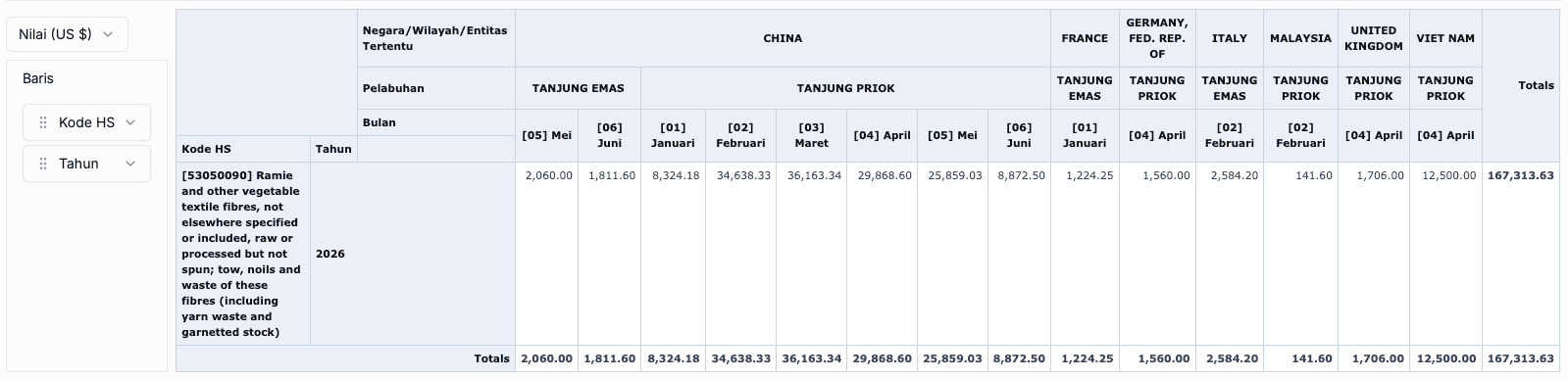
Meanwhile, Vietnam became the largest market in the ASEAN region, recording a transaction value of USD 12,500 in April. This was followed by Malaysia with a value of USD 141.60.
Export activity also extends into European markets, including Italy, the United Kingdom, Germany, and France, demonstrating the geographic reach of Indonesia’s coconut-derived products. In February, Italy even bought these products with a transaction value of USD 2,584.20.
Indonesia holds a strategic position in the coconut-derivative supply chain, supported by an equatorial climate that supports rich raw material supplies. This natural strength and production capacity make Indonesia’s coconut commodities highly competitive in global market requirements.
High global market demand requires Indonesia to focus on downstream processing and capacity expansion. This strategic move is crucial to ensuring long-term supply sustainability for both global and domestic markets.